
Agroecologisation
What would it mean to agroecologise socio-ecological relations at a time of climate breakdown, war and genocide? How does agroecology stop this destruction and refashion a new world?

Hopefully you can forgive me verbifying agroecology in order to try and make a point in this article. For what it’s worth, others have verbified it before! What I want to do is draw attention to how agroecology is often portrayed as a an idealised thing. It is often thought about as a set of ideal characteristics that someone/something either is or isn’t. This farm is agroecological, this one isn’t. What I think stems from this is a tendency to idealise a certain form of agroecology over other forms. And I think this creates a disempowering disconnect with the wider food system and world of agriculture. (For avoidance of doubt, I’m talking from what I know about the British approach – you can decide if this fits your geography.)
Agroecology is generally seen as a certain set of practices carried out by small farms oriented towards local markets. Less mechanisation and chemicals, and more people power and ecological diversity. Generally-speaking it’s conceptualised as a set of technical practices oriented towards a certain idea of ‘the market’ – the role of politics would be to institute such a vision. As such politics is generally understood as big P Politics as opposed to a vision of political struggle, which creates a bit of a bifurcation between the social movement and wider political struggle. Politics is lobbying, petitioning, meeting with elected representatives, implementing policy, rather than the process of cohering a mass of people powerful enough to effect political change over society. This hegemonic conception of politics within the agroecology movement of the global north contrasts sharply with the conception and practice of say Movimento sem Terra (MST) in Brazil. MST do engage with big P Politics but they’re also building autonomous popular power as way to build a revolutionary politics that could seize political power away from the elites. (I will leave it to others who know better to decide to what extent Lula’s politics of class conciliation, as put by Sabrina Fernandes, is serving elite interests or popular working class development.)
It is often stressed that agroecology isn’t just a set of technical tools and that agroecology is inherently political. But being inherently political doesn’t mean inherently virtuous (Starmer is political, but he’s not virtuous) and to what extent it is truly political is arguable and will depend on one’s theory of politics, and thus what can be conceived of as political. My concern is that the movement here has adopted quite a technocratic elite conception of politics that is disempowering, not only to those in the movement but disempowers the movement itself. For example, a recent textbook puts forward a strategic understanding of political agroecology that is focused on technocratic, institutional change. I think we must reject this conception of politics. Especially at a time when nearly every Western government is going through a process of fascisation, from UK’s Labour, to von der Leyen’s EU and plenty in-between. The struggle, now, as it always has been, is to build popular power, as epitomised by Brazil’s MST.
Political Agroecology is the politics of defeating the death-dealing, world-ending, ecodical, genocidal system of racial capitalism. It’s not about technical change at the top of society. We have a conception of political agroecology that has divorced the social from the political, much as the conception of the market is divorced from the political – i.e. a liberal theoretical conception. Reconciling these false bifurcations is necessary in order to politicise agroecology. Which brings us back nicely to verbifying and agroecologisation.
Fundamentally I think agroecology is about revolutionising socio-ecological relations – how humans make/remake ecosystems and re-orienting our current world away from climate devastation towards a vision of abundance whereby everything is for everyone. The abolition of racial, gendered, class society is necessary for the revolutionising in socio-ecological relations. A class society will always reproduce exploitation and expropriation of humans and non-humans.
Now, moving towards a more integrated understanding of society (and socio-ecological relations) is one thing but we must also heal the rifts of alienation – society isn’t agroecological, instead agriculture is currently central to the breakdown of ecological systems. But if agriculture is central to that breakdown, it can and must be central to rectifying that rift. And if that is the ultimate goal of agroecology, what is demanded of us in the movement?
I put forward that it’s less about defending a certain ideal of how we have come to imagine agroecology as manifesting e.g. localised food markets, and instead it becomes about transitioning socio-ecological systems away from genocide and ecocide and towards a way of living together (humans and non-humans) that is not premised on competition, war, and exploitation. A shift away from a commodity society (local or global in nature) towards production for what we actually need to live. To the extent that actions transition society towards such an aim on the level of agro-ecologies (the interaction of food/fibre/timber production with our ecosystems and societies) is the extent to which it facilitates the agroecologisation of society.
Building our alternatives was at one point seen as the objective of agroecology, and the theory of change being that adding up all of this would lead to systemic change. It hasn’t worked. Instead we are stuck in a global conjuncture of genocide and ecocide, with things like the collapse of AMOC becoming increasingly more likely. The goal of agroecology is stop this destruction and build not alternatives but construct an actually-existing alternative world out of the one we find ourselves in in order to replace the one we find ourselves in. A world that is liveable not just for a minority but for everyone. If that is the goal we measure ourselves by and orient ourselves to, how does the movement reconfigure its priorities, strategy and tactics?1
Perhaps we became so enamoured with our own gardens we retreated from the wider world, and in doing so neglected to contest the future for everyone. But for that to happen we have to agroecologise socio-ecological relations before the climate runs far beyond a liveable world. That might mean venturing out, winning others over, letting go of some of our preconceptions of what agroecology looks like and who it includes, building a bigger, popular movement and effecting change on a scale far beyond what we have so far achieved.
I’ve used this meme before and I’ll use it again!:
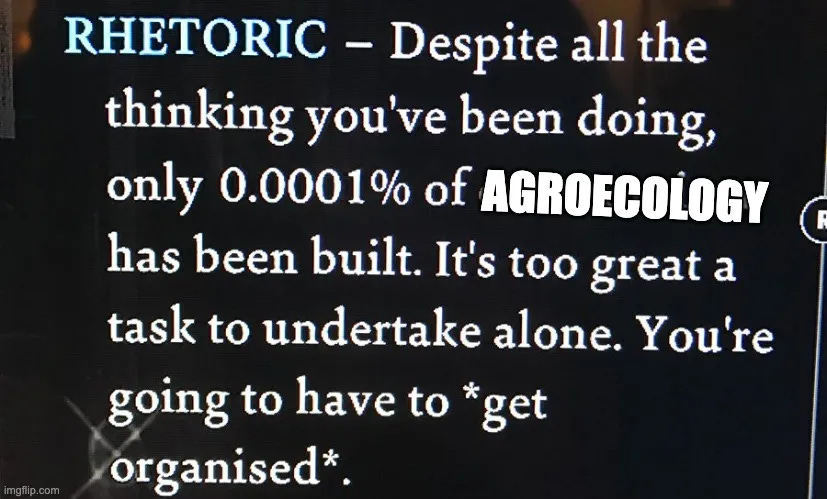
I think these lines from a recent piece in the Break-Down in an article on reading Stuart Hall for the climate crisis are relevant: ‘This is the “utopian aspiration” in Hall’s thought. But aspiration amounts to little without clear goals, a willingness to listen to people grumble, an ability to cooperate across difference, a detailed map, and a plan to transform small victories into more sweeping transformations. Such tasks are always performed by specific movements in specific contexts.’
self-sufficiency is a core tenet of agroecology, but that can’t define the political dimension!
Well said, I’m going to forward this to friends